Article
The naturally occurring blue molecule that changes the structure of your face — here’s what scientists know, and what you can do
A copper-binding peptide found in human plasma in 1973, why a real copper peptide solution is blue, and why the number on the label is almost never verifiable.
If you’ve spent any time in front of the mirror noticing that your face looks different — not necessarily more wrinkled, but like the shape itself has changed, particularly along the jawline and lower face — you’ve been observing something real.
It isn’t just “getting older.” It isn’t because you forgot to moisturize. And maybe you’ve even tried retinol, vitamin C serums, collagen creams and firming products and felt like none of them made a meaningful difference. There is a biological reason for that too.
The explanation begins, unexpectedly, with liver cells.
A discovery that started somewhere else
In 1973, Loren Pickart was not searching for an anti-aging ingredient.
He was studying something far less glamorous: the behavior of liver cells. At the time, researchers already understood that blood was more than a delivery system for oxygen and nutrients. Plasma — the pale liquid that carries blood cells through the body — was crowded with proteins, hormones and chemical signals. Somewhere in that mixture, Pickart suspected, there might be substances capable of influencing the way cells behaved.
While studying components isolated from human plasma, Pickart and his colleague Margaret Thaler identified an activity that changed the survival and growth behavior of liver cells. Their findings were published in 1973 in Nature New Biology.
The active material was eventually traced to a molecule consisting of only three amino acids.
Glycine. Histidine. Lysine.
Together, their initials gave the molecule its name: GHK — glycyl-L-histidyl-L-lysine. Its precise identity as the three-amino-acid peptide was reported several years later.
For something so small, its behavior was unusual. Researchers studying GHK noticed that copper seemed to follow it through the purification process. Copper and, to a lesser extent, iron repeatedly appeared alongside the peptide. It was a clue that the molecule might not operate alone.
Further experiments revealed that GHK had a strong ability to bind copper. When a copper ion attached itself to the peptide, the resulting complex became what researchers now call GHK-Cu — the copper peptide.
Where the blue comes from
Copper, when bound in a complex like this, absorbs light in the red and orange end of the spectrum. What remains — what reflects back — is blue. The same chemistry that makes copper sulfate blue and gives the Statue of Liberty its color is what gives a GHK-Cu solution its distinctive blue tint.
This matters more than you might think.
At a meaningful concentration, copper peptide is visibly blue. You can see it. At fairy-dust concentrations — the trace amounts many brands use just so they can print the ingredient on the label — the solution is clear. There isn’t enough copper peptide present to produce any color at all.
The blue is not a dye. It is the dose, made visible.
What declines, and when
But the discovery that made the molecule genuinely significant for aging came next. GHK was not present at the same concentration throughout a person’s life.
Researchers reported that the concentration of GHK in human plasma is roughly 200 nanograms per milliliter around age 20, but falls to approximately 80 nanograms per milliliter by age 60.
The bloodstream of a young adult contains substantially more circulating GHK than that of an older adult. And as GHK levels decline, many of the body’s regenerative processes decline alongside them.
Skin is where this becomes visible.
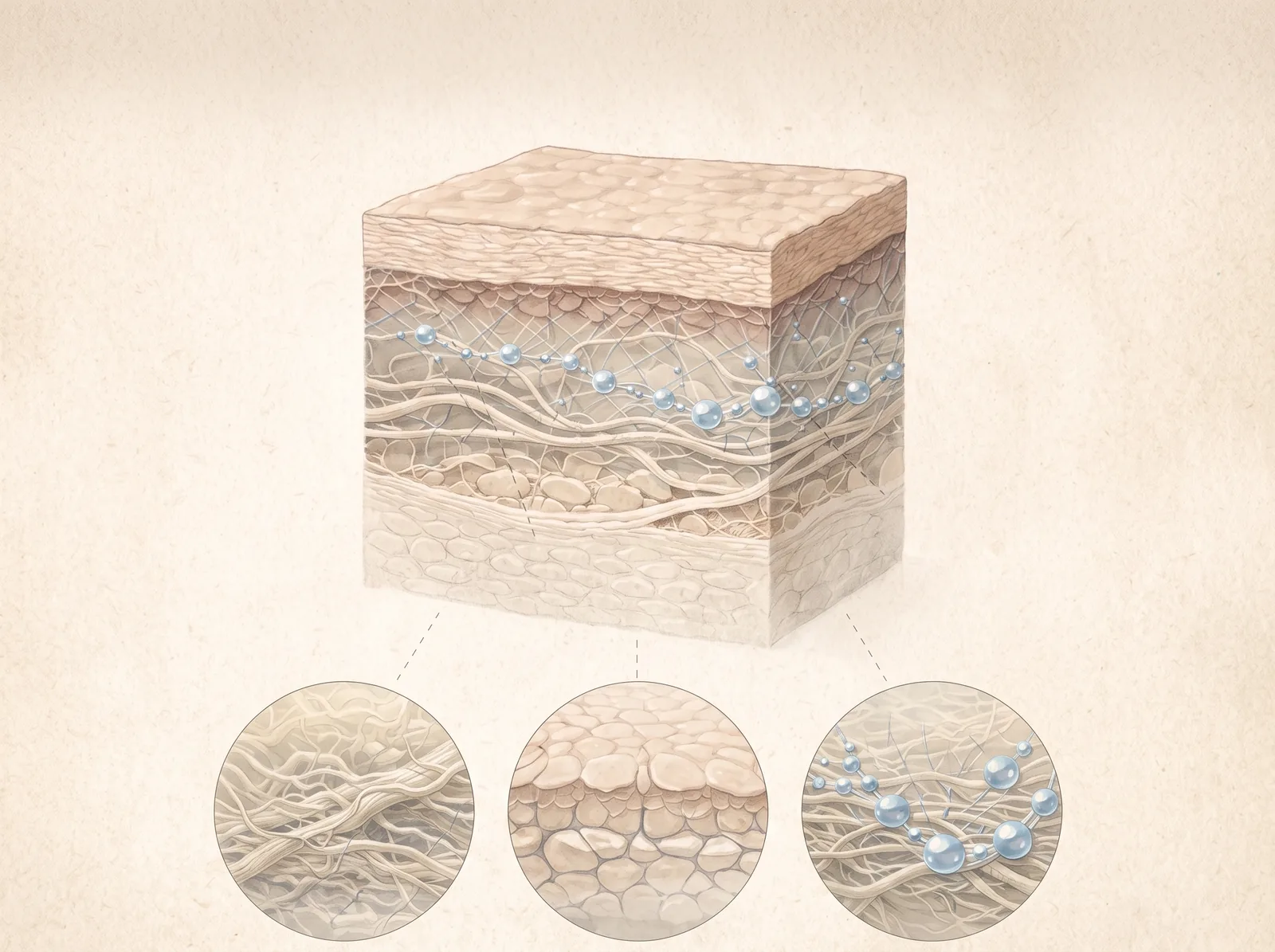
Young skin is in a constant state of maintenance. Fibroblasts — the cells that live in the dermis, the structural layer directly beneath the surface — produce collagen, elastin and other components of the extracellular matrix. Think of the extracellular matrix as the scaffolding that keeps skin dense, firm and resilient. Damaged proteins are cleared. New material is built. Wounds close efficiently.
Over decades, that process becomes less efficient. Collagen production decreases. Existing collagen becomes damaged and disorganized. Sun exposure accelerates the destruction. The scaffolding beneath the skin gradually becomes thinner and weaker.
What is happening microscopically eventually becomes visible in the mirror.
A structural problem, not a surface one
And this is the part that confuses most people — and the part that explains why so many products seem to fall short.
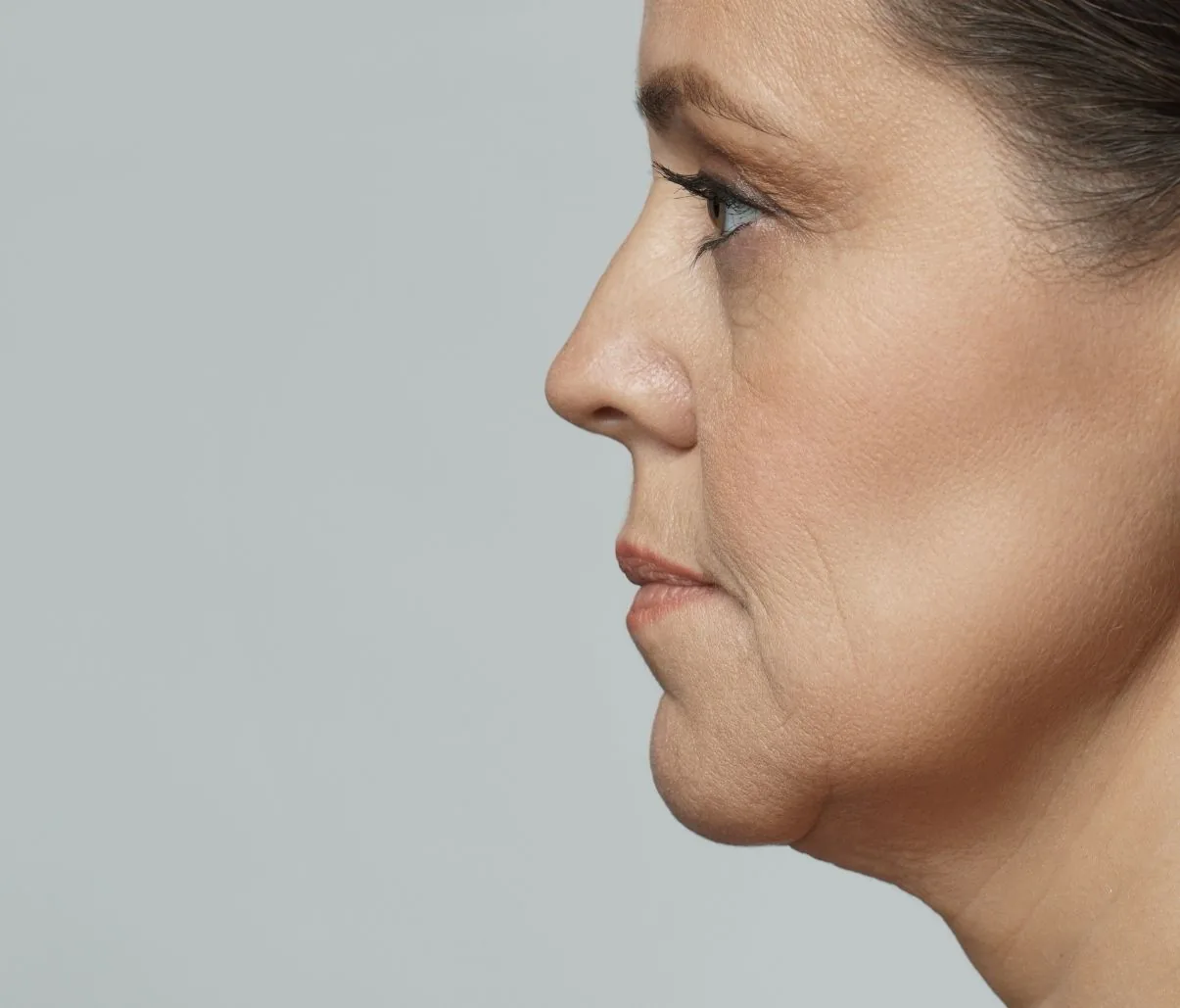
The changes you tend to notice first are not just surface marks. Fine lines are surface marks. But the softening of the jawline, the lower face looking heavier, the feeling that your face has changed shape even though your skin still looks reasonably good — that is not a surface problem.
That is a structural problem. It is happening in the dermis and below.
The collagen scaffold that used to hold the skin taut against the contours of the face has lost density. The skin still drapes over the same bones and tissues, but it has less internal support. And the lower face — especially the jawline — is where gravity makes that loss of support visible first.
Why the usual answers miss
This is why retinol often disappoints here. Retinol is effective at accelerating surface cell turnover and there is solid clinical evidence behind it for fine lines and photodamage. But retinol does not address the signaling gap underneath. It tells the skin to shed and renew its surface. It does not tell fibroblasts — a nerdy way of saying the small, hardworking cells inside your skin that act as builders and repairers — to build and maintain the structural proteins that keep the skin dense.
It is also why collagen creams rarely do what the label implies. Applying collagen to the surface of the skin does not become collagen inside the skin. The molecules are too large to penetrate the dermis in any meaningful way. You are essentially moisturizing with an expensive protein.
And it is why “firming” creams tend to work for about twenty minutes — tightening agents can temporarily contract the skin surface, but they do not change what is happening structurally beneath it.
A different level of action
GHK-Cu became interesting to researchers precisely because it appeared to operate at a different level.
Studies found that GHK-Cu could influence fibroblasts, the cells responsible for producing much of the skin’s structural matrix. Researchers observed effects on collagen production, wound repair, and the remodeling of damaged extracellular tissue.
GHK-Cu appeared to behave less like a material used to physically “fill” a wrinkle and more like a biological signal — part of the communication system the body uses to tell fibroblasts what to produce, how much, and when to repair.
That distinction matters.
A wrinkle is not simply a groove on the surface. It is partly the visible result of what has changed underneath: altered collagen architecture, degraded extracellular matrix, loss of elasticity, and decades of accumulated environmental stress. The softening of the jawline, the contour changes, the face that starts to look “different” — those are deeper manifestations of the same structural decline.
If you’ve tried retinol and found your skin can no longer tolerate it — stinging, burning, flaking where there used to be none — that shift is real. For many women over 45, changing hormone levels alter the skin barrier enough to make previously tolerable actives feel harsh. The most commonly recommended anti-aging ingredient becomes difficult to use at exactly the age when the skin needs the most structural support.
GHK-Cu works through a different pathway. It is not an exfoliant. It does not accelerate turnover. It is a signaling molecule — part of the body’s own communication with the cells that build and maintain the dermis.
And it was already there. Circulating in your blood from birth. More abundant in youth. Gradually declining with age.
It was not invented by a cosmetics company. It was not designed to treat wrinkles. It was discovered because a scientist was trying to understand why old and young cells behaved differently.
The concentration problem
Now here is the problem. GHK-Cu is widely available on the market. Many vendors sell products containing it. But most of them are fairy-dusted.
That means the brand puts a trace amount of copper peptide into the formula — just enough to print the ingredient on the label and charge a premium for it, nowhere near enough to produce a meaningful biological effect.
They get away with this because of a regulatory gap most people have never heard of.
Ingredient lists are required to be in descending order of concentration only down to 1%. Below that threshold, ingredients can appear in any order. Since most active ingredients in serums fall below 1%, the ingredient list on the back of the bottle tells you almost nothing about how much is actually inside.
So when a product says “copper peptide serum” and lists GHK-Cu on the label, there is no way for you to know whether it contains a meaningful concentration of the peptide or a tenth of a tenth of a percent.
How to check
Remember the blue.
A real copper peptide solution, at a concentration that corresponds to published research, is visibly blue. If the product in your hand is clear, there is not enough copper peptide present to produce any color. The chemistry does not lie.
There is one reliable way to verify what is in a copper peptide product: the Certificate of Analysis, or CoA. This is a document from an independent laboratory confirming that the product contains what the label says it contains, at the concentration stated.
Most brands will not provide one. Some will tell you the concentration is proprietary.
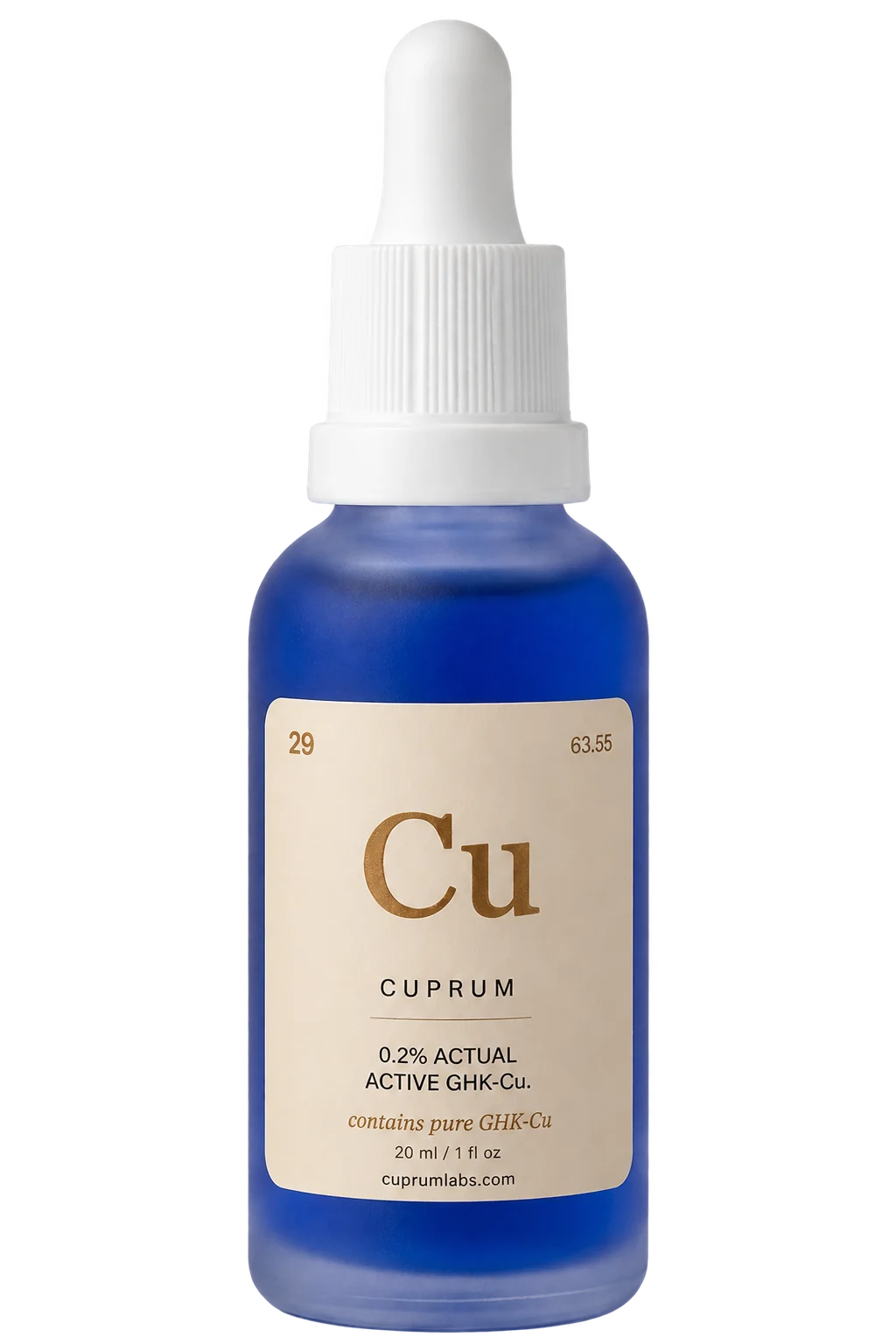
At Cuprum, the CoA is downloadable directly from the product page. Our serum contains 0.2% actual GHK-Cu — actual peptide, not a diluted solution percentage designed to look impressive. The concentration is printed on the label. The CoA confirms it. The product is formulated in Australia.
And it is blue.
What the molecule was
More than fifty years after Pickart’s first publication, GHK-Cu appears in serums, creams and experimental research devoted to skin aging.
But the history of the molecule remains unusual. It was not invented in a lab to solve a cosmetic problem. It was not designed to treat wrinkles. It was not marketed into existence.
It was already there.
A three-amino-acid signal circulating quietly in human blood, more abundant in youth, gradually diminishing with age — discovered not because someone was looking for younger skin, but because a scientist was trying to understand why old and young cells behaved differently.
The blue is the molecule. The molecule was always yours.
Notes and sources
- Pickart, L. and Thaler, M. M. “Tripeptide in human serum which prolongs survival of normal liver cells and stimulates growth in neoplastic liver.” Nature New Biology, 1973. The peptide’s identity as glycyl-L-histidyl-L-lysine was established in later work.
- The plasma figures quoted here — roughly 200 ng/mL around age 20, falling to approximately 80 ng/mL by age 60 — are as reported in the GHK literature. They describe circulating plasma levels across a population, not any one person’s skin.
- What is not known. Most of the mechanistic work on GHK-Cu comes from cell culture and animal models rather than large controlled trials in people. That a molecule influences fibroblasts in a dish is not the same as a measured cosmetic outcome on a face, and the published human work on topical GHK-Cu is small. Anyone telling you the effect size is settled is ahead of the evidence.
- Ingredient-order rules: under US labelling regulation, cosmetic ingredients must be listed in descending order of predominance only above 1%. Below that threshold they may be listed in any order.
- Our own batch results are published in full on Batch testing, and the dosing rationale on The Dose.