Article
The most studied anti-aging molecule in the world is one you’ve never been told about
A look at the published clinical numbers behind GHK-Cu — and what they reveal when placed next to retinol, vitamin C, and the rest of what’s on your bathroom shelf.
There is a moment, sometime after forty, when a woman realizes that her skincare routine is not doing what it used to do.
Not because she has stopped trying. Often because she has tried more diligently than ever. She has the retinol. She has the vitamin C serum in the dark glass bottle. She may have a collagen cream, a peptide something, a niacinamide. Her bathroom counter looks like a small pharmacy, and each product arrived with a promise backed by the word “clinically.”
And yet.
The mirror does not lie. Something is changing — not overnight, but steadily, and no amount of layering and waiting and hoping seems to be reaching whatever is happening underneath.
So you start to wonder: is it you? Is it the products? Or is there something the industry is not telling you about the biology of what is actually going on — and what, if anything, can reach it?
That question led somewhere unexpected. It led to the clinical research behind a molecule most people have never heard of, and to a set of published numbers that raise a genuinely uncomfortable question: what if the ingredient with the strongest data has been sitting in the margins while the weaker ones dominate the shelf?
Retinol, and what it costs the skin
Start with retinol. It deserves its reputation.
Retinol is a vitamin A derivative. Once it enters the skin and converts to retinoic acid, it accelerates epidermal cell turnover — essentially telling the surface to shed faster and rebuild. There are decades of controlled clinical studies behind it. In a 2016 study published in the Journal of Cosmetic Dermatology, 0.1% retinol reduced wrinkle scores by 63.74% at the cheeks and 38.74% around the eyes after twelve weeks. Prescription-strength tretinoin, at concentrations between 0.025% and 0.1%, has consistently shown fine-line reduction in the range of 40% to 60%.
Those numbers are real. Retinol works… kind of.
But here is the part that rarely makes it into the recommendation: the way retinol works is, by design, a controlled injury. It forces cells to turn over faster than they would on their own. That forced turnover is what produces the smoothing effect. It is also what produces the peeling, the redness, the stinging, the dryness, and the increased sun sensitivity that most users experience for somewhere between two and six weeks — a period the skincare community has come to call, with dark affection, the “retinol uglies.”
This is not a side effect. It is the mechanism. You cannot push cell turnover at that rate without temporarily compromising the skin barrier. One clinical assessment documented an 88% increase in transepidermal water loss during retinol use. The barrier weakens in order for the renewal to occur.
The question that we must ask is: are there better alternatives to retinol?
The answer to that question has been sitting in the scientific literature since 1973.
A molecule found in blood
That year, a biochemist named Loren Pickart was working at the University of California — not on skincare, not on cosmetics, but on something considerably less glamorous: why old liver cells behaved differently from young ones. He was studying blood plasma, the pale liquid component that carries cells through the body, looking for chemical signals that might explain the difference.
What he found was a molecule consisting of just three amino acids. Glycine. Histidine. Lysine. Together, their initials gave it a name: GHK. Further work revealed that GHK had a strong affinity for copper, and when a copper ion bound to the peptide, the resulting complex — GHK-Cu — appeared to be the biologically active form.
In the half-century since, more than 400 peer-reviewed studies have been published on this molecule. It has been examined by labs on multiple continents. And when you sit down with the actual data — the kind with subject counts, control groups, and objective measurements — the numbers that emerge are difficult to reconcile with the molecule’s near-total absence from mainstream skincare conversations.
The biopsy study
Consider the study most people have never seen.
In 1998, Abdulghani and colleagues ran a comparative trial. Four topical treatments. Human skin. One month. What made this study unusual was that they did not ask volunteers how their skin “felt.” They took biopsies. They put the tissue under a microscope. They used immunohistological analysis to look for the actual molecular markers of new collagen production — procollagen synthesis, the precursor to the structural protein that keeps skin dense and firm.
Three of the treatments were compared directly: a copper peptide cream, a vitamin C cream, and retinoic acid — prescription-strength retinoid, the most potent topical form available.
- Copper peptide cream
- 7 of 10
- Vitamin C cream
- 5 of 10
- Retinoic acid
- 4 of 10
The copper peptide stimulated new collagen production in 7 out of 10 subjects. A 70% response rate.
Vitamin C achieved it in 5 out of 10. Fifty percent.
Retinoic acid — the gold standard, the one your dermatologist recommends — achieved it in 4 out of 10. Forty percent.
Read those numbers again, because they are not what most people would expect. The ingredient with the highest collagen-stimulation response rate was the copper peptide. The ingredient with the lowest was the prescription retinoid. And the copper peptide achieved its result with no peeling, no retinization period, no sun sensitivity, and no documented barrier compromise.
This study has been cited in peer-reviewed literature for more than twenty-five years. It has not been contradicted.
Measured in three dimensions
That was a small study. Fair enough. What happens when the measurements get more precise?
In 2016, Badenhorst and colleagues published a randomized, double-blind clinical trial in the Journal of Cosmetic Dermatology. Female volunteers applied GHK-Cu in a nanocarrier formulation twice daily for eight weeks. The control groups used either the carrier alone or the commercially available peptide Matrixyl® 3000 — one of the most widely used anti-wrinkle peptides on the market.
The results were measured with 3D skin surface imaging. Not questionnaires. Not “do you feel younger?” surveys. Three-dimensional topographic measurement of the physical geometry of the skin.
Against the control serum, GHK-Cu reduced wrinkle volume by 55.8%. Wrinkle depth dropped by 32.8%.
And against Matrixyl® 3000 — the peptide in some of the most expensive serums on the market — GHK-Cu produced a 31.6% greater reduction in wrinkle volume.
For context: Matrixyl’s active molecule, palmitoyl pentapeptide-4, has been shown to reduce wrinkle depth by up to 20% in twelve weeks. GHK-Cu nearly tripled that performance in eight.
Beneath the surface
Then there is the ultrasound study. Carey and Pickart tracked 21 subjects who applied GHK-Cu gel daily for three months. They used high-resolution ultrasound imaging — a method that can measure dermal thickness and collagen density without a biopsy, looking directly beneath the surface to see what is structurally happening inside the skin.
The average increase in collagen density across all subjects was 28%. The strongest responders saw increases of 51%.
That is not a surface effect. It is not a tightening agent creating an illusion for twenty minutes. It is a measured structural change in the density of tissue beneath the skin, verified by imaging, within twelve weeks.
Leyden and colleagues ran a larger trial: 71 women, twelve weeks, GHK-Cu cream applied twice daily to the face. The subjects had mild to advanced signs of photoaging. The results showed improvements in skin density, thickness, laxity, clarity, firmness, fine lines, and wrinkle depth. Essentially every measurable dimension of visible facial skin aging moved.
A separate eye cream study by Abdulghani applied GHK-Cu around the eyes of 41 women for twelve weeks. The copper peptide outperformed both placebo and a vitamin K cream.
One molecule, many genes
At this point, a reasonable person might ask: how can one molecule affect that many things?
This is where GHK-Cu becomes genuinely strange — and genuinely interesting.
Most active skincare ingredients work on a single pathway. Retinol hits retinoic acid receptors. Vitamin C donates electrons. Niacinamide supports ceramides. One mechanism, one category of results. That is how most pharmacology works.
GHK-Cu does not seem to work that way.
Using the Broad Institute Connectivity Map — a publicly available database of transcriptional responses maintained by MIT and Harvard — Pickart and colleagues analyzed gene expression data and found that GHK modulates more than 4,000 human genes. That is approximately 32% of the genome.
Fifty-nine percent of the affected genes are upregulated — turned on. These are genes involved in DNA repair, antioxidant defense, collagen synthesis, extracellular matrix production, stem cell activity, and anti-inflammatory signaling.
Forty-one percent are downregulated — turned off. These are genes associated with chronic inflammation, tissue degradation, cellular senescence, and the biochemical signatures of accelerated aging.
The pattern is directional. Damage genes quiet down. Repair genes activate. Researchers have described the effect as shifting gene expression from an “aged” cellular profile toward a “younger” one. Not by adding a foreign substance. By reactivating signaling that was already there.
Most pharmaceutical compounds target one receptor. GHK-Cu appears to recalibrate a system.
That observation comes from over 400 published studies. It is not a claim. It is a pattern that keeps replicating.
Something you used to have more of
And this is the part that makes the biology feel personal.
GHK was not invented. It was not synthesized. It is a molecule your body already makes. It circulates in your blood. It appears in your saliva and your urine. It has been there since you were born.
At age 20, plasma GHK concentration is approximately 200 nanograms per milliliter. By age 60, it has fallen to roughly 80 nanograms per milliliter. A 60% decline.
That decline tracks uncomfortably well with what you see happening in the mirror: slower wound healing, thinner skin, reduced collagen density, diminished structural firmness, a face that looks subtly but unmistakably different from the one you remember.
You are not imagining the change. You are observing, among other things, the visible consequence of having less of a molecule you used to have more of.
So we have a molecule that outperformed prescription retinoids and vitamin C on collagen stimulation. That reduced wrinkle volume by more than half versus control. That increased collagen density by 28% on average and 51% in top responders. That modulates a third of the human genome in a direction associated with tissue repair and youth. That the body produces naturally and loses with age.
And it does all of this without peeling your skin, without increasing your sun sensitivity, without forcing a retinization period, and with zero documented barrier breakdown.
Why you haven’t heard about it
The practical question is not whether science is interesting. It is: why haven’t you heard about this?
Part of the answer is regulatory. GHK-Cu is a cosmetic ingredient, not a drug. It cannot be marketed with treatment claims. That limits how loudly any company can talk about it.
Part of the answer is commercial. Retinol is cheap to formulate, universally recognized, and carries decades of dermatological endorsement. The infrastructure of recommendation is built around it. Shifting that infrastructure requires confronting the established order, and most brands would rather ride it.
And part of the answer — the part that should concern you — is concentration. GHK-Cu works at the concentrations used in the published research. At trace amounts — the minuscule quantities many brands use just to print the ingredient on a label — it does not work. There is not enough molecule present to produce a biological effect.
The fairy-dust problem
This is not a hypothetical problem. It is standard practice.
Ingredient labels are only required to be listed in descending order of concentration down to 1%. Below that threshold, brands can list ingredients in whatever order they like. Since most active ingredients in serums fall well under 1%, that back-of-bottle list tells you almost nothing about how much of anything is actually inside. A brand can put a fraction of a fraction of a percent of GHK-Cu into a formula, print “copper peptide” on the front label, charge a premium price for it, and never once lie in the legal sense. This is what the industry quietly calls fairy-dusting — just enough of an ingredient to earn the claim, nowhere near enough to do what the claim implies.
You have almost certainly bought a fairy-dusted product before. Most people have. There was no way to know, because the label was built to make that impossible to know.
This is why Cuprum prints the actual number. Not “contains copper peptide.” Not a proprietary blend. The concentration — 0.2% actual GHK-Cu — is stated on the label itself, at the level used in the published research, verified by an independent lab.
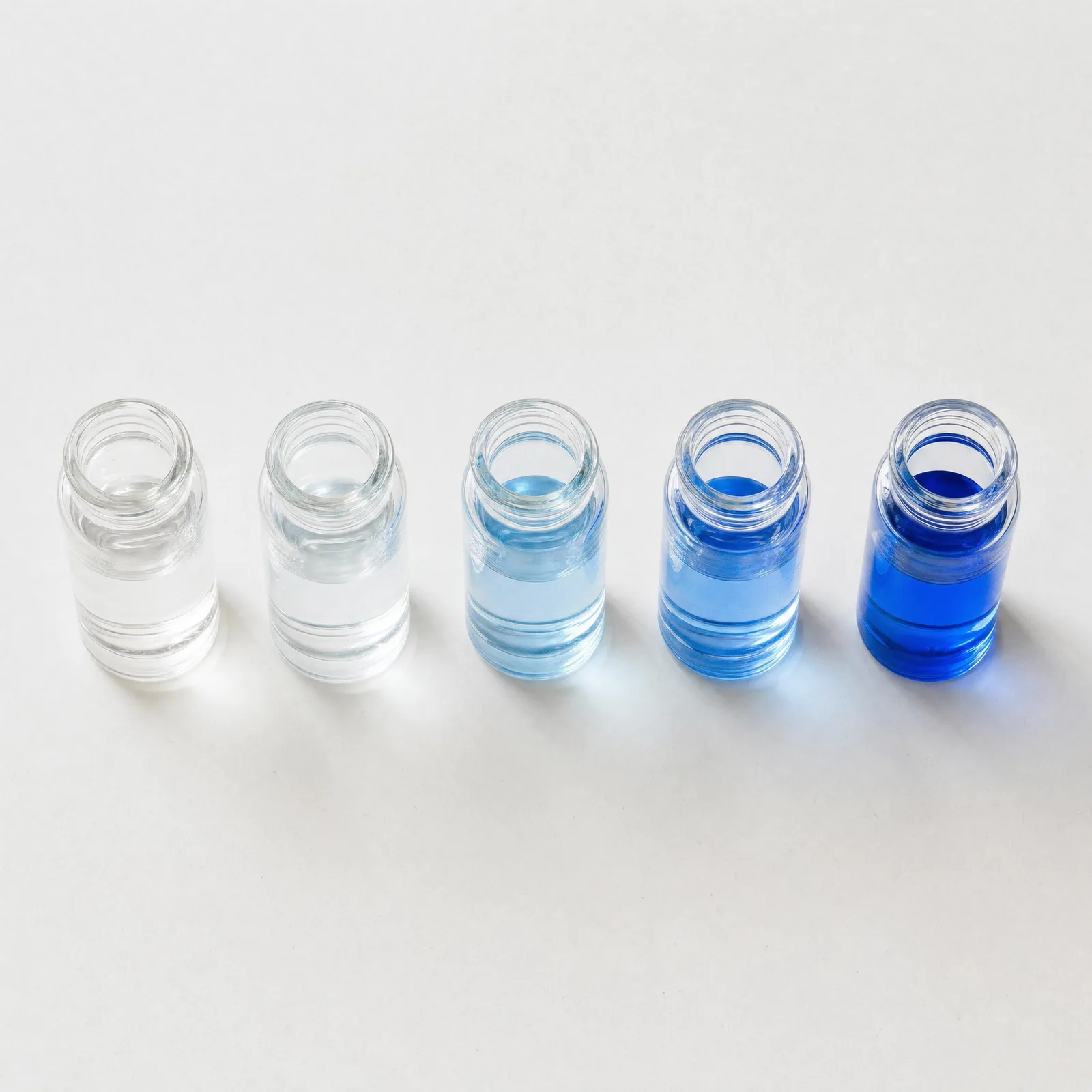
There is a simple way to tell. At a meaningful concentration, a GHK-Cu solution is visibly blue. Copper, when bound in this peptide complex, absorbs red and orange light and reflects blue. The same chemistry that makes copper sulfate blue and the Statue of Liberty green gives GHK-Cu its color. If the product in your hand is clear, there is not enough copper peptide in it to produce any color at all.
The blue is not a dye. It is the dose, made visible.
What it can and cannot do
A responsible accounting of what this molecule can and cannot do matters here. It matters because the skincare industry is full of claims that blur the line between “improves the skin” and “rebuilds the face.” Those are not the same thing.
GHK-Cu is not a drug. It is not a facelift. It will not reposition tissue that has descended, rebuild bone that has remodeled, or move a fat compartment back to where it was ten years ago. No topical can do those things. Anyone who implies otherwise is selling a fantasy.
What the published evidence supports is that GHK-Cu can measurably improve the skin envelope — the collagen scaffold, the extracellular matrix, the biological signaling that governs how fibroblasts build and maintain the structural layer of the skin. For the component of aging that lives in the skin itself, the clinical data is, by the numbers, stronger than the data behind the ingredients most women have been told to use first.
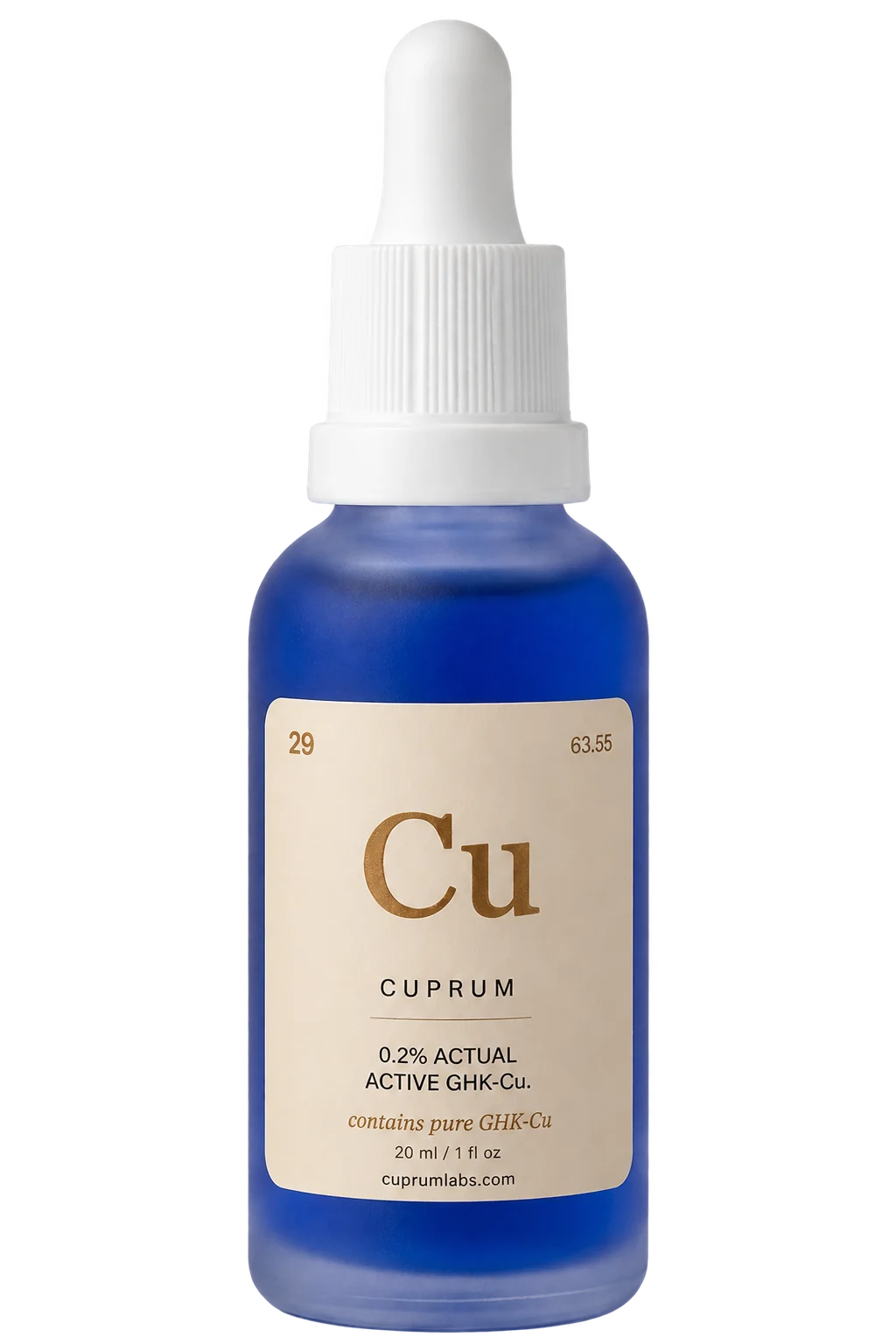
There is one manufacturer whose product is formulated at a concentration that corresponds to published research, states the percentage on the label, and makes the Certificate of Analysis — the independent laboratory confirmation of what is actually inside — downloadable from the product page.
The concentration is 0.2% actual GHK-Cu. Actual peptide, not a diluted-solution percentage designed to look impressive. The product is formulated in Australia.
And it is blue.
Because at a concentration that means something, copper peptide is always blue. The chemistry does not lie.
Selected references
- Pickart, L. & Margolina, A. (2018). Regenerative and Protective Actions of the GHK-Cu Peptide in the Light of the New Gene Data. International Journal of Molecular Sciences, 19(7), 1987.
- Badenhorst, T. et al. (2016). In vitro and in vivo evaluation of GHK-Cu nano lipid carrier formulations. Journal of Cosmetic Dermatology.
- Abdulghani, A. et al. (1998). Effects of topical creams containing vitamin C, a copper-binding peptide cream and melatonin compared with tretinoin on the ultrastructure of normal skin. Disease Management and Clinical Outcomes, 1.
- Leyden, J. et al. (2002). Randomized controlled trial of a cosmetic formulation containing GHK-Cu on facial skin of women with photoaging.
- Carey, M. & Pickart, L. Collagen density increases measured by ultrasound imaging following three months of topical GHK-Cu application.
- Pickart, L., Vasquez-Soltero, J.M. & Margolina, A. (2012). GHK and DNA: Resetting the Human Genome to Health. BioMed Research International.
- Kong, R. et al. (2016). A comparative study of the effects of retinol and retinoic acid on histological, molecular, and clinical properties of human skin. Journal of Cosmetic Dermatology, 15(1), 49–57.
- On sample sizes. The biopsy comparison ran ten subjects per treatment and the ultrasound study twenty-one, so a single responder moves those percentages by several points. The gene-expression figures come from database analysis of cell responses, not from measurements in human skin. Read the numbers as a consistent direction, not a guaranteed outcome.